
There are plenty of things to see and do in Paris—so many that you most likely won’t be able to see them all. We have written this short guide, “The best things to do in Paris,” to help you choose the most important ones. So, if you want to learn more about them, please read on.
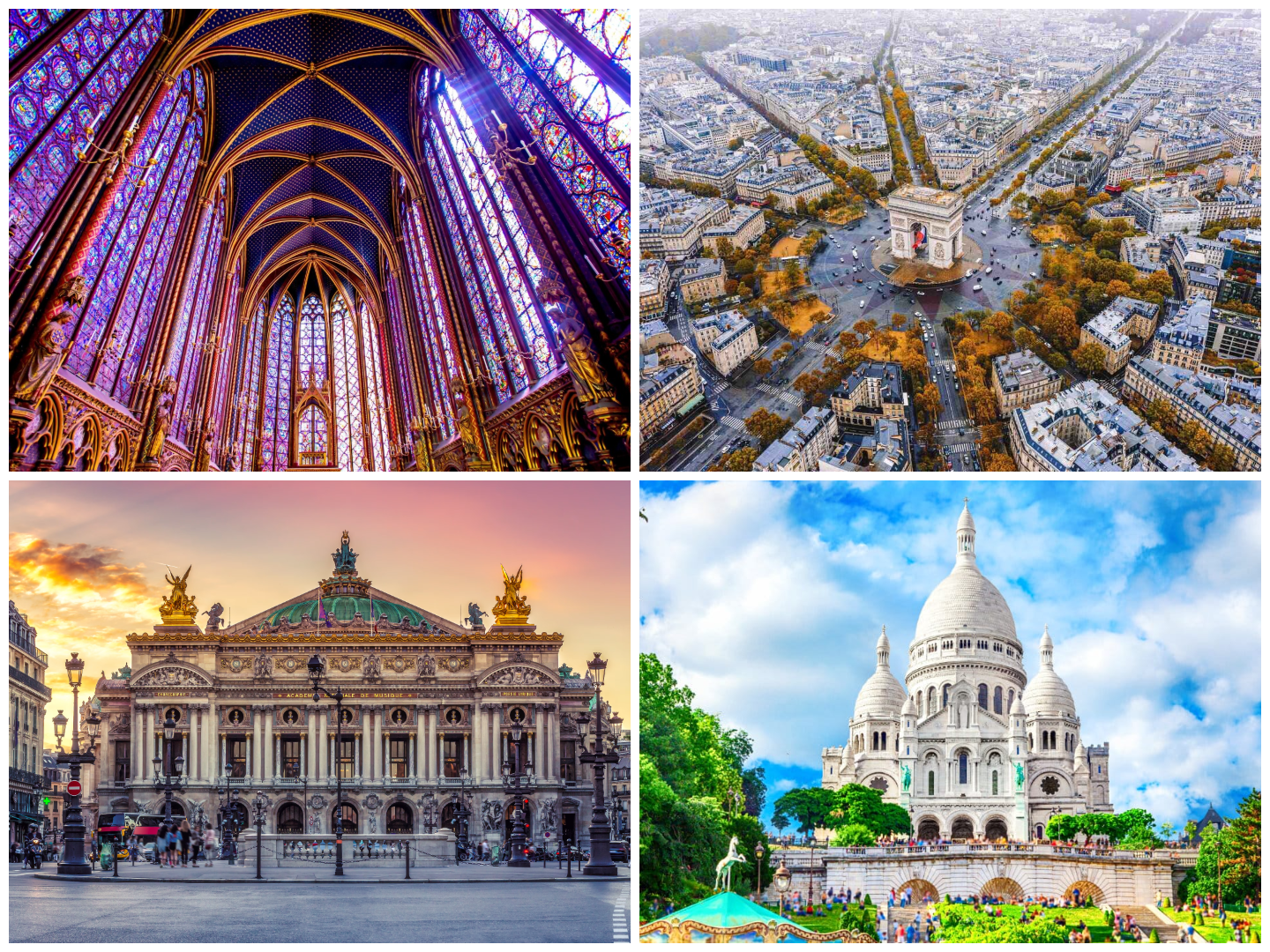
From upper left: Sainte-Chapelle, Place Charles de Gaulle (Etoile), Palais Garnier, Sacré-Cœur, Paris (Montmartre)
Our website includes affiliate links. So, remember that we may receive commissions when you click our links and make purchases. Please read our legal disclaimer document for more information about our Affiliate disclaimer and other disclaimers like the Fair-Use disclaimer.
Overview of the Best things to do in Paris
Paris, a city of grandeur, offers a wealth of experiences, from charming sidewalk cafés to glittering boutiques, from world-class museums to a legendary restaurant scene. To guide you through this grandeur and help you avoid common tourist pitfalls, we’ve curated a list of must-see attractions in Paris. The city’s rich history is reflected in the monumental buildings that French rulers, from kings to emperors to presidents, have erected to glorify themselves and the city. From Napoleon’s era to Mitterrand’s legacy, these monuments are a testament to Paris’ grandeur.
Our List of the Best things to do in Paris
Admire Paris’ iconic rooftops.
Talk of inscribing Paris’ iconic rooftops on UNESCO’s World Heritage List has been rumbling for years. Begin your rooftop foray at ground level on Place des Vosges, laid out as Place Royale in Le Marais in 1612. It’s the city’s oldest square – and the most handsome. This is an ideal spot to admire Paris’ signature roofs from below, initially tiled in slate from the nearby Loire Valley and, from the mid-19th century, with cheaper sheets of shiny seagull-grey zinc.
Just a 10-minute stroll away, on the trendy Rue Vieille du Temple, 3e, fashionistas gather over cocktails, barbecued meats, and weekend brunch at Au Top, a hidden rooftop with an unparalleled 360-degree panorama. Le Perchoir Marais, another exclusive rooftop, is a must-visit in the neighborhood.
Local tip: Other Parisian-packed venues to swoon over the city’s romantic skyline include the viewing terrace of department store Galeries Lafayette, Perruche above Le Printemps, cocktail and DJ hub Le Perchoir in the 11e, and farm-to-fork Le Perchoir, at home on Europe’s largest urban farm in the 15e on—guess what—a rooftop.
Visit The Louvre
The Louvre is a famous museum established in the late eighteenth century. It is widely recognized and one of the most famous museums in the world, drawing over 8 million visitors annually. The museum is large and contains so many rare and unique works of art that it is challenging to see everything in one go. We suggest booking a tour to avoid long lines and go directly to the Mona Lisa. Visitors who want to get a general feel of the Louvre and view the most significant paintings, sculptures, and other types of art should plan to spend a whole morning there. The Louvre is so extensive that it can take several days to explore its exhibitions. Some must-see artworks include the Mona Lisa, the Venus de Milo, and the Winged Victory of Samothrace.
Take a Day Trip to Versailles
The next one is one of the best things to do in Paris, if not the best. If you can bear to leave the city center, a day trip to Versailles is well worth it. Just half an hour by train from Paris, Versailles is a royal castle on the outskirts of Paris (France). This World Heritage castle was once the official royal residence for over 100 years until the French Revolution in 1789.
At Versailles, visitors can visit the Palace of Versailles inside and explore the magnificent manicured Versailles Gardens, beautifully decorated with fountains and other water games. Also, be sure to visit the nearby Le Petit Trianon, designed by order of King Louis XV for his long-term mistress Madame de Pompadour, or L’Hameau de la Reine, which was once the quarters of Queen Marie-Antoinette.
Take a city view from the Arc de Triomphe Paris
One of two triumphal arches Napoleon built to celebrate his victories, this well-known Paris monument has one of the city’s best panoramic views. We love looking, in one direction, along the Champs-Elysées to the Louvre and, in the other direction, all the way out to the Grande Arche at La Defense.
To distinguish it from its more minor brother, the Arc de Triomphe du Carrousel, this arch is formally referred to as L’Arc de Triomphe Paris de l’Etoile. The etoile is the 11-road traffic circle surrounding the monument, resembling a star. Let’s stroll to the top of the Champs-Elysées to learn the story behind the Arc.
Tip: On its roof, you can enjoy marvelous city views for a much more affordable price than in the Eifel Tower. Furthermore, we recommend downloading the Arc de Triomphe app before you go. This app provides interesting facts about the Arc de Triomphe and helps you identify buildings you see from the terrace.
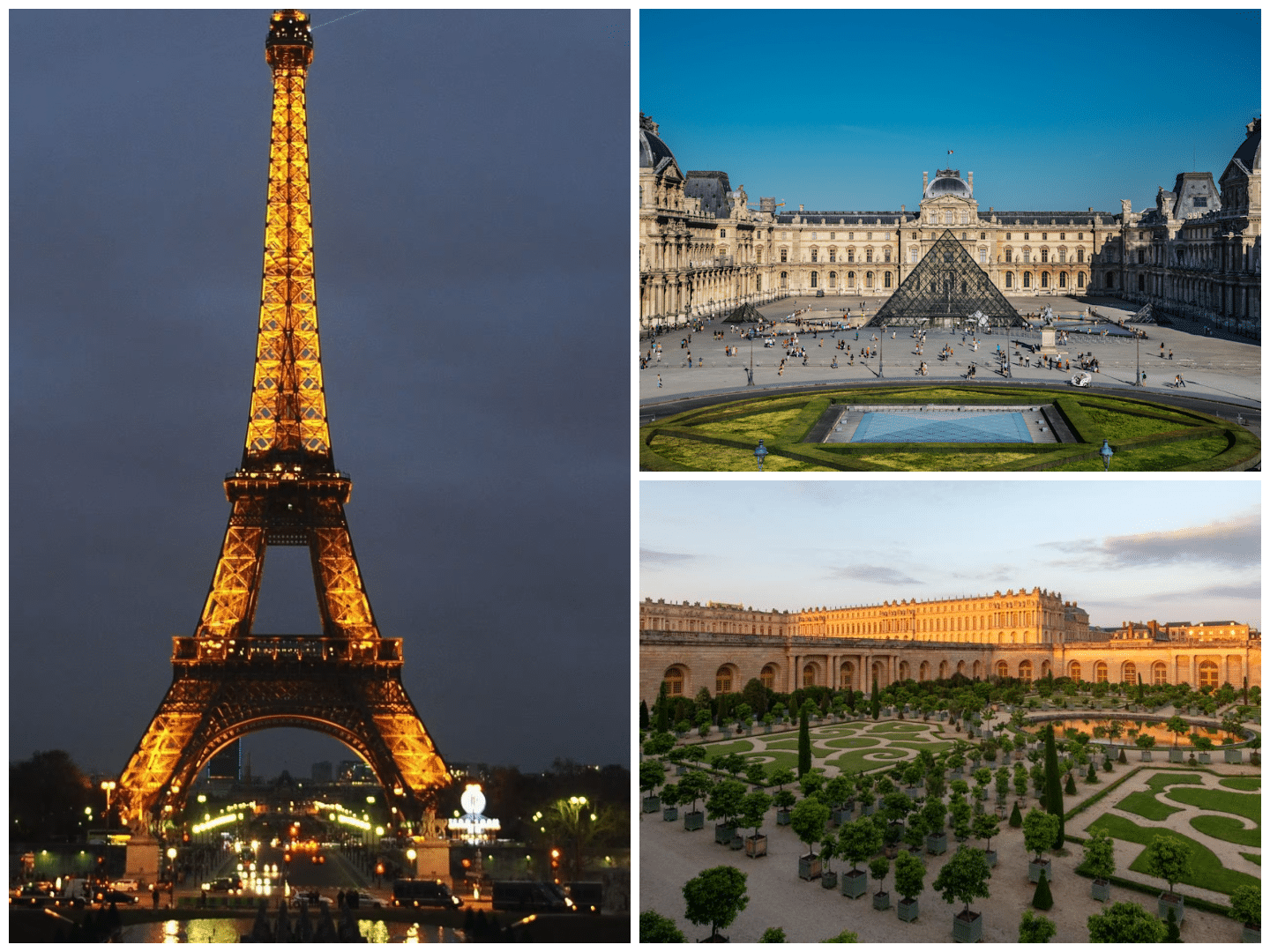
The Eiffel Tower, the Louvre museum, and Versailles palace are among the most popular attractions in Paris. ©Getty Images
Visit the Eiffel Tower – The Easy Way
One of our top recommendations is always to book a skip-the-line guided tour whenever possible. Paris is a bustling city, and its top attractions always draw crowds. If you arrive without a plan, you might be disappointed or stuck in long queues. We’ve learned from experience that a guided, skip-the-line tour is the best way to make the most of your visit, especially at the iconic Eiffel Tower. So, take our advice and readers’ feedback, book your tour in advance, and enjoy a hassle-free visit to the top.
We used to think we could do it all alone, but we learned our lesson the hard way. Now, whenever one is available, we always opt for a guided, skip-the-line tour. That is particularly true of the world’s most famous Eiffel Tower monument. So, take a tip from us and our readers and get to the top without the hassles of waiting in long lineups. It’s easy, and, honestly, it’s the only way to do it.
Travel tip: We strongly advise booking your tickets in advance. This will save you hours. We also recommend booking your tickets as soon as you know your travel dates. During peak season, tickets often sell out almost as soon as they become available, 60 days in advance. Here are a few of the recommended tours.
Insider tip: The Eiffel Tower is all about the Paris views. Agree? However, waiting in long queues for the entrance is time-consuming. That’s why we recommend visiting the Montparnasse Tower or the Arc de Triomphe to enjoy equally fascinating views for a more affordable price.
Notre Dame Cathedral and Île de la Cité
Île de la Cité is a small island in the center of Paris, home to both Sainte-Chapelle and Notre Dame. This island is known as the historic heart of Paris. The cathedral, dedicated to the Virgin Mary, is one of the world’s oldest and most renowned Gothic cathedrals. Its towers provide stunning views of Paris (France).
Built between 1163 and 1245 on Île de la Cité, Notre Dame de Paris, which translates to “Our Lady” in English, is dedicated to the Blessed Virgin Mary. Over the past eight centuries, the cathedral has undergone several renovations. The most significant restoration took place from 1845 to 1870. During this time, the flying buttresses were replaced, the chapel was restored, additional statues were added, and a new rose window was installed.
Many important events have occurred at Notre Dame, including the coronation of Napoleon Bonaparte, the beatification of Joan of Arc, and the coronation of Henry VI of England.
On April 15, 2019, a severe fire damaged the roof and the central tower’s spire. As a result, Notre Dame Cathedral is closed to the public while reconstruction work is ongoing. Although it is scheduled to reopen at the end of 2024, visitors cannot access the cathedral or the surrounding square at this time.
Sainte-Chapelle
Sainte-Chapelle is a Gothic chapel on Île de la Cité. It was the home of French kings until the 14th century. The chapel has one of the world’s most extensive collections of 13th-century stained-glass windows. During the French Revolution, people vandalized Sainte-Chapelle because it was associated with royalty. Some stained glass was broken, but about two-thirds of it remains. The stained glass was removed and stored during World War II for protection.
Sainte-Chapelle was significantly restored from 2008 to 2015. Visit the official website for pricing, hours, and to reserve tickets in advance.
Shakespeare and Company
Shakespeare and Company is an indie bookstore across the Seine from Notre Dame. It has a rich history has welcomed many famous authors, such as Ezra Pound, Gertrude Stein, Ernest Hemingway, F. Scott Fitzgerald, and more recent writers like Zadie Smith. The shop is filled with antique bookshelves, a resident cat, and an old piano upstairs, all adding to its charm. The café is an excellent spot for people-watching, and you can enjoy a café au lait while listening to conversations. It also serves the famous lemon pie the original owner, George Whitman, created.
Have a Traditional French Breakfast and a cup of coffee
There’s no better way to start your day in Paris than with a delicious French breakfast. Petit déjeuner is the French word for breakfast, which means ‘little lunch’ since déjeuner is used for lunch.
The typical French breakfast is sweet (more on this later). It is not a big sit-down meal, and it’s simpler and lighter than in other countries. It does not include scrambled eggs, beans, omelets, or sausages because the French like to eat a heartier meal for lunch.
Admire the Jardin du Luxembourg
The Jardin du Luxembourg is a popular park in the Sixth Arrondissement of Paris. It offers a green space for both locals and tourists. You can watch people, take romantic walks, have picnics, or enjoy the blend of English, Italian, and French garden styles. If you want to be active, join the morning joggers or use one of the tennis or pétanque courts

On the first two photos is Montartre distrcit with its famous basilica. On the last photo is Pantheon in the Latin quartier. ©/travelmate.tech
Experience village life in Montmartre
Gorging on the spectacular Paris vista that unfolds from the steps of the pearly-white domes of the Sacré-Coeur Basilica – or atop the 300 more steps spiraling up inside the church dome – is a veritable Montmartre moment. But to get under the skin of this fabled quarter of ivy-clad cottages, windmills, and artist cafés, it pays to duck down hidden alleys and squares and explore less-visited streets on the backside of the Butte (as the Montmartre hill is known).
Local tip: Reserve a table at the clandestine cocktail bar Le Très Particulier, with a walled summer garden, in a 19th-century mansion on Ave Junot. Mooch a couple of doors downhill to Villa Leandré at No 23, one of the picturesque cul-de-sacs in Paris with flowery cottage gardens fronting 1920s, terraced brick houses. Another 15 minutes brings you to La Cité Pilleux (45 rue Ganneron, 18th arrondissement), an equally bucolic dead-end lane with old industrial workshops repurposed as pretty little dwellings.
Discovering the Latin Quarter
The Latin Quarter (Quartier Latin) is south of the Île de la Cité. It is one of Paris’s liveliest and busiest areas.
The area was named “Quartier Latin” during the Middle Ages, when the inhabitants of this neighborhood, the students of the University La Sorbonne, studied Latin.
Since the Middle Ages and today, students living in the Latin Quarter have greatly influenced the rest of the city. During the nineteenth and twentieth centuries, students organized movements of great political importance. One such movement was the May 1968 revolt, a general strike that nearly brought down the French government of the time.
After crossing Place de Saint Michel, where a towering fountain depicts Saint Michael fighting a dragon, you enter the Quartier Latin, a maze of small, charming streets full of reasonably priced restaurants and cafés with terraces. Although several streets offer good restaurants, the main artery is Rue Huchette, which is always a good option.
The Panthéon
The Panthéon is the first prominent monument in the French capital, predating both the Arc de Triomphe and the Eiffel Tower. It offers an unparalleled panoramic view of the Latin Quarter and is conveniently located near the Jardin du Luxembourg.
Constructed between 1764 and 1790, the Panthéon was initially designed by Jacques Germain Soufflot and later enhanced by Jean Baptiste Rondelet. This architecture mixes the simplicity of architecture with the grandeur of Greek aesthetics.
A visit to this iconic landmark is an unforgettable experience. It consists of two distinct parts: the awe-inspiring interior of the mausoleum, where visitors are captivated by its vastness and exquisite decoration, and the crypt, which houses the tombs of celebrated French figures such as Voltaire, Rousseau, Victor Hugo, Marie Curie, Louis Braille, Jean Monnet,…
Take a stroll on the Champs-Elysées.
The Champs-Elysées is a famous 1.9 km long avenue in Paris. It connects the Arc de Triomphe and the Place de la Concorde. This busy street is known for shopping and is a must-visit in Paris.
The avenue is lively day and night, with luxury shops, cafés, and the popular Laduree for macarons. Cars are not allowed on the first Sunday of each month, making it great for walking.
The Champs-Elysées started in 1640 and was extended in 1724. It was renovated in 1994. Sports fans know it as the finish line for the Tour de France. The avenue also features many bars, cafes, and Michelin-starred restaurants, making it an excellent spot for dining and nightlife.
Place de la Concorde
Place de la Concorde is a prominent square between the Tuileries Garden and the Champs-Elysées in Paris. This historic site witnessed the executions of King Louis XVI, Marie Antoinette, and Robespierre during the French Revolution. It is the second-largest square in France and features the Luxor Obelisk, a 22-meter-high monument gifted to France in the 1830s.
The square was a gathering place during the Revolution, during which 1,119 people were guillotined from 1792 to 1793. After the period of terror, the square was renamed Place de la Concorde. It remains an important landmark, with notable buildings like Hotel de Crillon and Hotel de la Marine.
The Musée d’Orsay
The Musée d’Orsay in Paris houses the world’s most extensive collection of Impressionist and post-Impressionist masterpieces, featuring artists such as Monet, Van Gogh, Renoir, and Degas. Housed in a former railway station near the Louvre, it is one of the most visited museums in the world. It showcases artworks from the 19th and early 20th centuries, along with remarkable sculptures and decorative art.
In addition to its permanent collection, the museum regularly offers temporary exhibitions. For art lovers or those wanting to explore Paris’s cultural history, visiting the Musée d’Orsay is a must.
Pro Tip: The museum is most crowded on Tuesdays and Sundays. If you visit, aim for lunchtime (noon) to avoid the crowds.
Pompidou Centre
The Centre Pompidou is a famous building in Paris. Its unique design features colorful pipes on the outside. It is the largest modern art museum in Europe. The museum is worth seeing, even if you’re only interested in its fascinating architecture.
You can ride the elevators to the top for a great view of Paris. You can see the Sacré-Coeur, Notre Dame Cathedral, and the Eiffel Tower from there. For just 5€, you can buy a ticket to access the top and enjoy the view without visiting the entire museum.
A travel tip: There’s a French restaurant called Georges on the rooftop of the Pompidou Center. We found it overpriced for what we got. We suggest trying Les Ombres, which offers a fantastic view of the Eiffel Tower and serves better food, as well as a better view of Paris.
Note: The Centre Pompidou will close entirely at the end of summer 2025 for five years to address safety, sustainability, and accessibility issues. The nearly fifty-year-old building is scheduled to reopen in 2030.
Attend the Moulin Rouge cabaret
After its opening night, the Moulin Rouge became known for its energetic and provocative French Cancan dance style. The lively high kicks and ruffled skirts helped build the cabaret’s fame. Thanks to Toulouse-Lautrec’s posters, they became a symbol of the Moulin Rouge.
So, if you’re looking for something to do in the evening, consider visiting the Moulin Rouge, the most famous cabaret in the world. Colorful cancan dancers perform every night at 7:00 p.m., 9:00 p.m., and 11:00 p.m. With your ticket, you can enjoy sparkling champagne while watching the show Feerie.
Our tip: We wouldn’t go again because Toulouse-Lautrec’s is a unique experience that anyone visiting Paris should have. Still, it isn’t worth the money. We suggest just attending the show instead of having dinner.
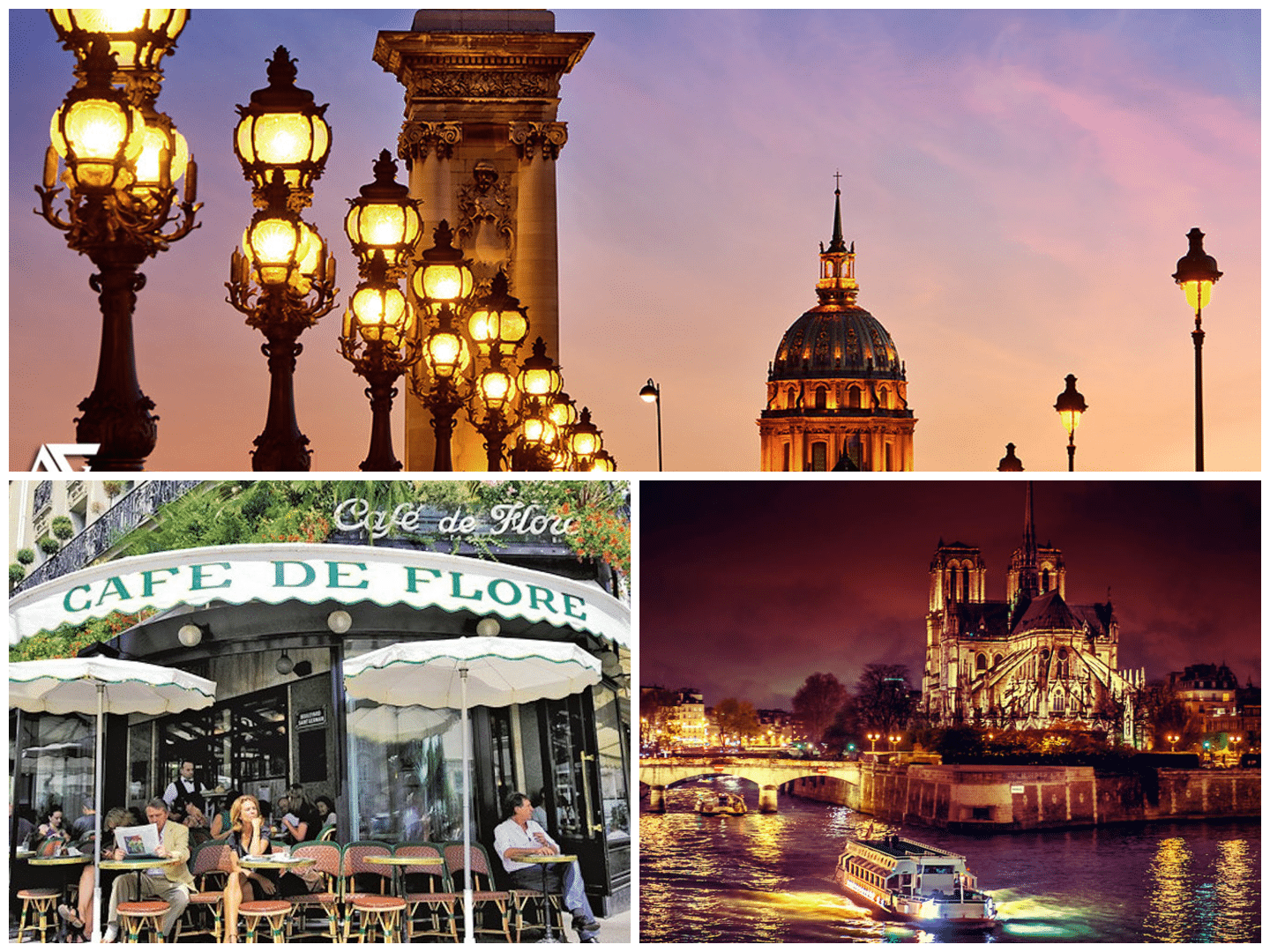
In Paris you can do many leisure activities, such as going on a Seine river cruise, or strollong on the famous Pont Alexandre III, or even go for a cup of coffee.
Canal Saint-Martin
This one won’t come to your mind instantly when thinking about the top things to do in Paris. However, it will amaze you. The Canal Saint-Martin is a small waterfront area featuring antique shops and cafes that are popular with locals. So, if you want to escape the tourist crowds, this place is ideal for a quiet afternoon and dinner. The area attracts younger Parisians because of its lower rents and vibrant restaurant scene. You can find it in the 10th and 11th Arrondissements. Moreover, the streets around the canal are filled with cafés, ethnic restaurants, and well-known spots like Le Verre Volé and Chez Prune. The Canal Saint-Martin is lively and features a mix of boutiques, cafes, and bars. It’s a great place to find both hidden gems and popular attractions, making it one of Paris’s best areas.
See Paris City Lights from a Seine Boat Cruise
Paris is a beautiful city during the day. Still, it becomes magical when it lights up at night, cruising along the Seine River, which is the perfect way to witness the city’s iconic landmarks and monuments. Different Seine River Cruises are available in Paris. You can choose a dinner cruise or enjoy drinks while sailing down the river. It’s one of the best things you can do in Paris, so take advantage of the experience.
Drink a coffe at Café de Flore
Yes, we are again mentioning the coffee. And no, we still haven’t finished our list of the best things to do in Paris. Café de Flore feels like a step back to when the Left Bank was a lively area for artists like Pablo Picasso and Ernest Hemingway. The inside looks the same as during the Art Deco era, with red booths, mahogany, and polished brass railings. The best seats are outside on the sidewalk, where you can enjoy great people-watching, especially now that the terrasse is fully open again. This café captures the essence of Paris’s café culture. Afternoons are perfect for sitting outside and soaking in the energy of Boulevard Saint-Germain. Still, there is also a lively scene at night. In short, a city is a good time to visit.
Walking across Pont Alexandre III is one of the best things to do in Paris!
The Pont Alexandre III is Paris’s most extravagant bridge, adorned with nymphs and golden statues. It symbolizes the strong ties between France and Russia. Inaugurated during the 1900 Paris Universal Exhibition, the bridge’s foundation was laid by Tsar Nicholas II in 1896, commemorating the Franco-Russian Alliance.
The bridge, measuring 154 meters in length and 45 meters in width, connects the Esplanade des Invalides to Avenue Wilson Churchill, leading to the Champs-Elysées. It’s been a historic monument since 1975, featuring four towering pylons, gilt-bronze figures, and copper nymph reliefs representing the Seine and Neva. Over a century later, the bridge remains unchanged, restored to its original pearl grey color. It offers stunning views of the Esplanade des Invalides, Petit Palais, and Grand Palais.
Visit the Le Palais Garnier opera house
The Palais Garnier, built in 1875 for Napoleon III, is one of the most beautiful buildings in Paris, boasting an elaborate exterior. Inside, the Grand Staircase gives a dramatic feel, perfect for a “Phantom of the Opera” moment. Admission costs about 15 euros, and exploring the opera house feels like stepping into the past. The Opéra National de Paris will resume performances in mid-July, and a health pass will be required for entry. You can visit the Palais Garnier on your own or use multimedia audio guides to learn more about it. These guides offer stories and historical details that enhance your experience.
Stroll down the Père Lachaise cemetery.
Père-Lachaise cemetery is a unique Parisian monument, park, and open-air museum that attracts over 3 million visitors annually. Named after Father François d’Aix de La Chaise, it combines an English-style park with a place of meditation. Notable figures interred here include Honoré de Balzac, Colette, Eugène Delacroix, and Jim Morrison, whose grave draws large crowds annually.
Furthermore, the cemetery features romantic elements and artistic sculptures, with 5,000 trees, including a century-old maple and unique specimens like a wig tree. From season to season, Père-Lachaise transforms, offering different atmospheres and stunning photographic opportunities, making it a cherished space for reflection and exploration. And if the commentary is on our list, then you know that it must be truly magnificent.

Paris is not just a famous architecture. You can also eat delicious food there, or smell excellent parfumes, or even go for more shopping.
Go shopping at designer boutiques.
Paris offers a range of shopping options, including Louis Vuitton, the oldest candlemaker, and eco-friendly fashion stores. Le Marais and Canal St-Martin are perfect for shopping. La Samaritaine is a historic department store that underwent a €750 million restoration. Avoid shopping exclusively on the Champs-Elysées. Instead, visit emerging neighborhoods like North Marais, rue du Château d’Eau, and Les Halles to shop from local designers.
Visit a local boulangerie in Paris.
Plan a visit to a local bakery in Paris to savor classic French pastries, such as pain au chocolat, pain au raisin, and croissants. Du Pain et Des Idées is a favorite for its escargot croissants, shaped like snails. While traditional flavors are delightful, they offer unique options like red fruits. For larger groups, have one person place the order while others find a seat outside. Experiencing a Parisian bakery is a charming way to enjoy French culture, whether for breakfast or a snack.
In France, bakeries are typically known as boulangeries, which specialize in freshly baked bread, pastries, and sandwiches. A boulangerie must bake its bread on-site, while a pâtisserie specializes in sweets. Croissants are a must-try in Paris, and with so many boulangeries on nearly every corner, it can be overwhelming to choose.
Create your Parisian Perfume
Have you ever wanted to make your perfume? Well, in Paris, you can. You have undoubtedly dreamt of the day you would find your fragrance. One that is exclusively yours. The scents and smells will remind you of fond memories of people, places, and things that seduce you. There are various perfume workshops where you can design your fragrance. While concocting your scent, you’ll also learn about perfume history. Most perfume workshops last an hour or two. At the end, you’ll take home your creation.
To summarize, here is our curated list of the best things to do in Paris. We have made every effort to narrow it down significantly. If you have any additional suggestions, we would love for you to share them in the comments below.
If the Best Things to Do in Paris weren’t enough for you, and you still have the time, you can read our related article about the best day trips from Paris.
Take a look at
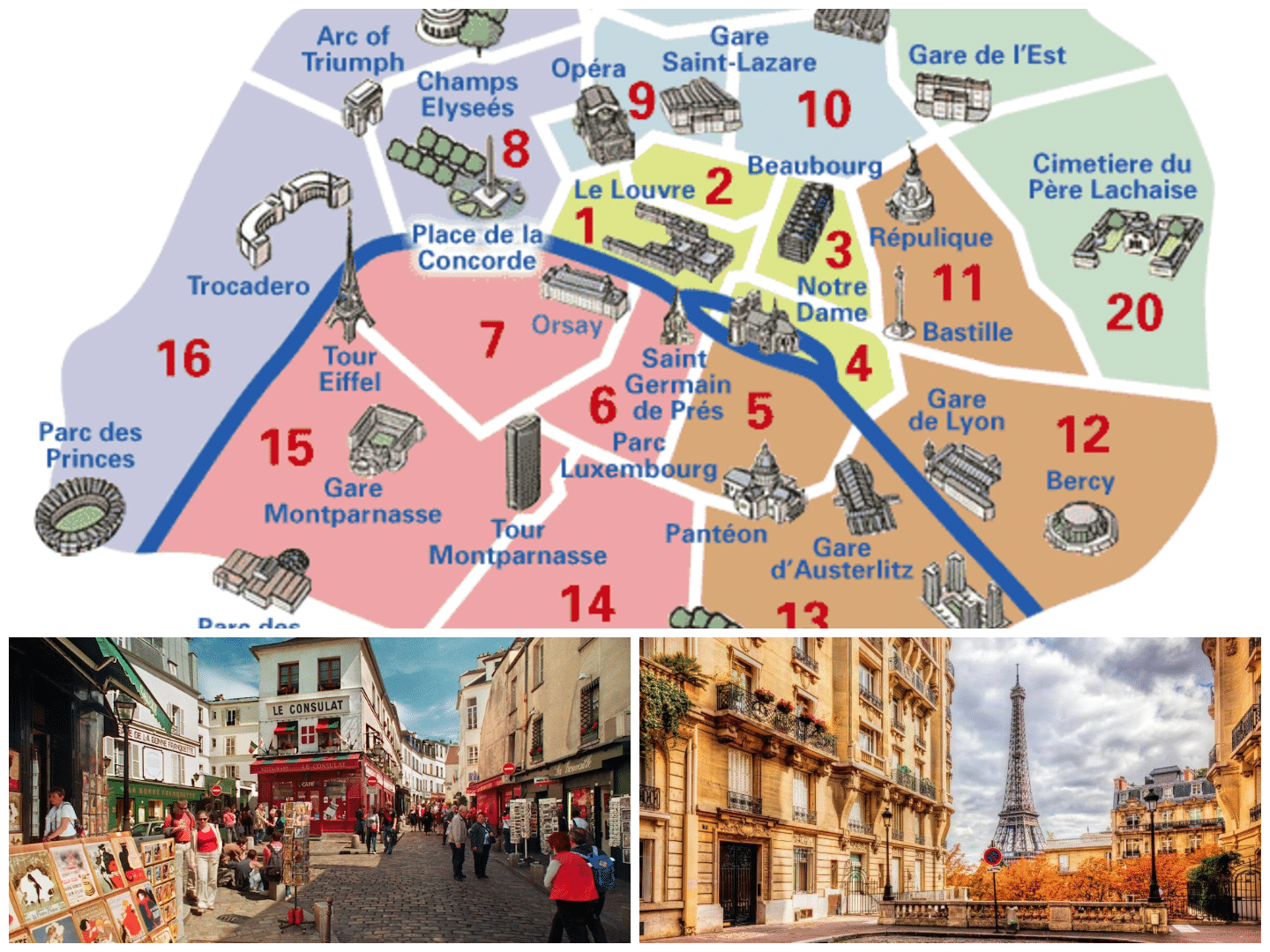
Where to stay in Paris
In this article, “Where to Stay in Paris,” we’ll show you the safest and most dangerous areas in the city
Lavender Guide – Provence
This Provence lavender guide will provide you with information about this famous plant, its uses, and its history. Furthermore, we
How to plan your trip to Provence
Have you chosen Provence (France) as your next holiday destination? Here’s some information to help you decide how to get
Photo credits:
Shutterstock